You’re a star in the making. Feel good?
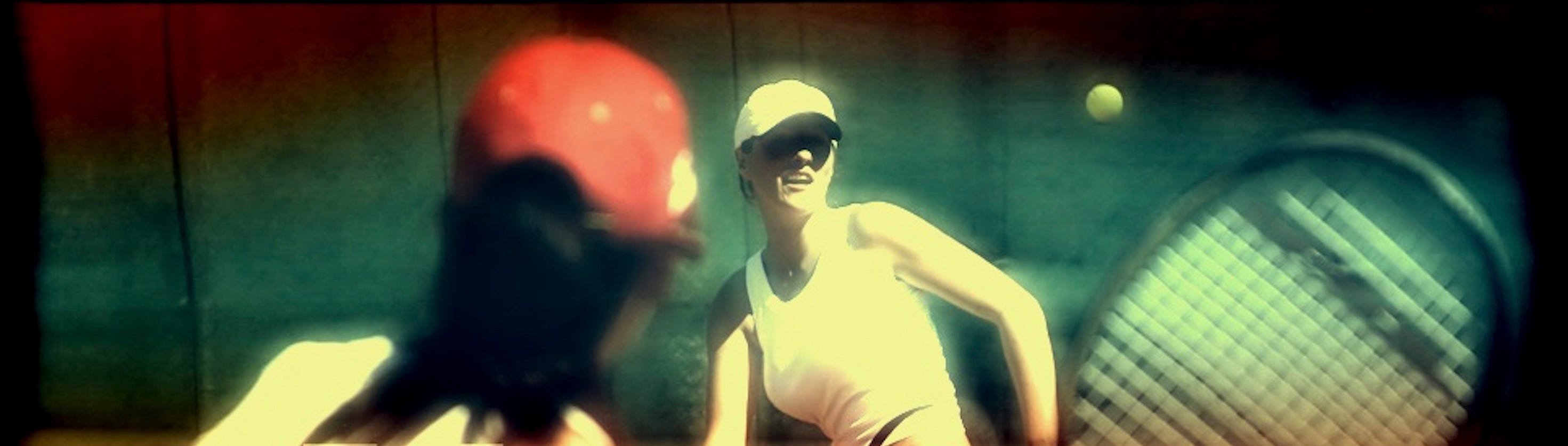
Now nothing is working, her serve has gone limp, her movement is sluggish. As the games tick away panic clouds her judgment. She tries to make every serve an ace, every groundstroke a winner, most miss and the sense of panic rises, a self-defeating loop.
IT’S SUPPOSED TO BE FUN BY ZACH SWISS 34THPARALLEL MAGAZINE ISSUE 42
January, Australian Open, Melbourne:
Practice courts crowd early. Her favorite is Court 15, third in a cluster of four backed by a row of eucalyptus trees. Before noon stifling heat radiates up from the blue court. After noon the trees cast confounding globular shadows, every shot requires heightened concentration. The Wednesday before the tournament the number-one men’s seed practices on Court 16. Between her rallies she watches with reverence the beautiful ease of his backhand as he strikes ball after ball after ball.
Each night she, father, coach repair to the patio of a small seafood restaurant three blocks from Port Phillip, close enough to the bay for the pungent maritime brine to hover overhead and the occasional belch of a ship’s horn to puncture dinnertime conversation.
They split entrees: prawns the size of saucers smoked and speared on long wooden skewers, glossy sardines doused in pools of thick olive oil, trout baked in foil with lemon wedges, capers and kalamata olives. The owner, a jolly man called Barney, chats with them each night and plies them with special treats: appetizers, desserts, post-dinner coffee which she politely declines—rigid pre-match diet and such. “That’s alright,” he tells her. “When you win, coffee and treats for days.”
The draw is selected Thursday. That evening they sit in the fading light on the restaurant’s patio and analyze her prospects. She and her coach decide that her quarter, with the third and seventh seeds at either pole, is, if not perfect, at least promising, the seventh seed having failed to advance past the fourth round of the last five Grand Slams and the third seed only recently recovered from knee surgery. “She’s vulnerable,” her father, who’s been listening silently, contributes as he finishes the final octopus tentacle. “You can beat her.”
Scattered phrases reach her mid-swing as her father, who usually disregards pre-match prognostication, reads aloud: “one of the tournament’s youngest”, “impressive recent victories”, “uncommonly powerful forehand”. Across the net, her coach continues to feed her shots. “The Los Angeles Times says you’re a player to watch and a star in the making,” her father summarizes. “Feel good?” She drills a forehand, low, flat, and deep. Her coach lunges but there’s nothing he can do, it lands in the corner and sails on untouched.
Her second first round match is on Court 9. Her opponent, a 32-year-old journeywoman ranked 141, earned her main draw berth with a grueling three-hour victory in the final round of the qualifying tournament and, beneath the broiling midday sun, the toll of the past week appears too great and the task at hand too formidable for there to be any uncertainty as to the outcome. It’s over in 58 minutes.
Prior to her second-round match, she perches cross-legged in the steamy locker room calibrating music to mood and vice versa. The room buzzes with pre-match energy and anxiety. In a nearby cluster tour veterans chat animatedly about retired competitors while younger players silently test grips and re-tie shoelaces with an attentiveness that belies shaky nerves. On her phone she scrolls past jagged rap and syrupy pop and selects a rock song she associates with trips in her family’s minivan to and from cracked neighborhood courts. An hour or so later when she returns victorious, humming the song to herself, the locker room has a new crop of chatty veterans and anxious youngsters arrayed where the others had been earlier.
She’s never before reached the third round of a major. Her opponent has, in eight years, never not reached the third round in Melbourne alone. Earlier in the week, as the evening sky darkened over Barney’s patio, they’d lingered on the opponent’s name in the draw, a former top 20 player, one-time Wimbledon semifinalist, touted in the early days of her career as a superstar in the making, now unseeded. A dangerous landmine, they’d concluded.
But the danger fails to materialize, she wins in straight sets, never facing so much as a break point.
It’s hot, too hot. Between games ball-girls ferry fresh ice towels to the players, depositing the used towels in soggy heaps along the back wall. “Fucking barbaric,” the seventh seed hisses at the chair umpire during changeover, heavily accented words drenched in disdain and sweat. The ice towel wrapped snake-like round her neck is dripping on her shirt, down her back, onto the blue hard court with a faint sizzle. In the stands, fans languidly clutch umbrellas to shield the sun but there is no relief to be had from the heat. Scanning the stadium from her chair the umbrellas undulate in the heat haze, entrancing dancing pastels, shimmying and shaking. “C’est ridicule,” her opponent says through clenched teeth as they rise to resume play.
Their strategies are the same, keep points short. Unforced errors accumulate as they spray shots wide and long, desperately aiming for lines and corners at increasingly unrealistic angles, a heedless plan any other day but in the afternoon broil of Rod Laver Arena, self-preservation. Three successive points end in drop shot winners, neither gives chase as the balls tauntingly dribble just over the net.
Ultimately more of her shots find their targets. After it ends, with an ice towel draped round her shoulders, she lumbers dazedly to the exit, and only later that evening, watching match footage on her hotel bed with air-conditioning cranked to full blast, does she hear the announcer’s parting words, “the breakout star of the tournament and the future of American tennis”.


